
Landscape decoration is not just about placing a few flower beds along a fence. Transforming a garden into a unique space requires a combination of soil analysis, the choice of sustainable materials, and a plant composition logic across multiple layers. Here, we discuss the technical levers that make the difference between a generic layout and a truly distinctive outdoor space.
Vegetal Layers and Soil Structuring in Landscape Decoration
A visually functioning garden relies on a superimposition of clearly hierarchical vegetal layers: ground cover, medium herbaceous plants, structural shrubs, and a high canopy. Each layer plays a specific role in managing light, drainage, and local biodiversity.
Before any planting, we recommend a soil diagnosis (texture, pH, water retention capacity). A heavy clay soil will not support the same species as a sandy, well-draining soil. Ignoring this parameter condemns half of the chosen plant palette to languish or disappear within two seasons.
Structuring also involves shaping the terrain. Creating gentle mounds or oriented depressions allows for managing runoff without costly underground systems, while adding relief to a flat space. This leveling work, often overlooked in purely decorative approaches, is crucial for the sustainability of the entire project.
Specialized professionals like those listed on lejardinierdecorateur.com integrate this type of analysis from the design phase, which avoids costly revisions after two or three years.
Materials and Mineral Elements: Balancing Aesthetics and Aging
The choice of materials defines the character of a garden just as much as the plants do. Natural stone, class IV treated wood, corten steel, exposed aggregate concrete: each option ages differently depending on exposure, ambient humidity, and planned maintenance.
Corten steel develops its protective patina within a few months and requires no further treatment. It is suitable for flower bed borders, raised planters, and vertical partitioning elements. However, it permanently stains adjacent light surfaces (limestone paving, white plaster) through oxide runoff.
Wood remains the most versatile material for decks, pergolas, and pathways. We prefer naturally durable species (black locust, chestnut) over treated softwoods, whose longevity heavily depends on the quality of the industrial treatment.
- Local natural stone (sandstone, schist, granite depending on the region): higher initial cost, but immediate landscape integration and lifespan exceeding several decades without maintenance
- Exposed aggregate or permeable concrete: suitable for driveways, helps limit soil sealing while maintaining a walkable surface
- Mineral mulch (pumice, crushed slate): an alternative to organic mulch in windy or sloped areas, with a pronounced graphic effect
- Calibrated pebbles and gravel: useful in transitions between planted areas and circulation zones, but should be stabilized with geotextile to prevent migration into the substrate
Ornamental Edible Garden: Merging Decoration and Production
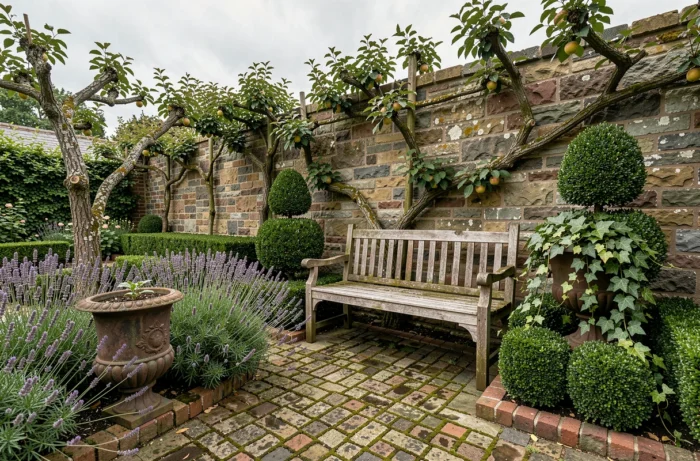
The trend of the ornamental edible garden goes beyond simply integrating a vegetable patch into the decor. It involves composing complete landscape scenes where leafy vegetables, herbs, and trellised fruit trees occupy the same spaces as classic perennials.
A concrete example: a low hedge of lavender and common sage bordering a square of colorful Swiss chard and kale creates a contrast of textures and colors that can be exploited from spring to autumn. The successive blooms of the herbs attract pollinators, directly benefiting the neighboring vegetable production.
This approach reduces the area dedicated to purely ornamental maintenance without sacrificing aesthetics. However, it requires mastering plant associations (allelopathy, compatible water needs) and accepting a less “tidy” appearance than precisely trimmed perennial beds.

Water Management and Lighting: Two Elements that Transform the Garden’s Atmosphere
Water structures an outdoor space just as much as mineral elements do. A shallow pond, a linear canal, or a simple sheet of water creates a focal point and alters the perception of volumes. The mirror effect of a calm water surface visually enlarges small gardens.
On the technical side, a closed circuit with a low-consumption pump is sufficient for most fountains and water sheets. Potable water supply is not necessary: rainwater harvesting, filtered by a simple decanter, feeds the system without additional costs on the bill.
Low Voltage Landscape Lighting
Lighting radically transforms a garden as night falls. We work with low voltage (12 V or 24 V) for safety and installation flexibility. Recessed lights at the base of trees or in stone walls highlight volumes without creating light pollution.
- Ground-level lighting for pathways: functional marking that outlines the garden’s lines at night
- Adjustable projectors aimed upwards at remarkable trees: immediate sculptural effect
- LED strips integrated into pond edges or terrace steps: visual continuity between mineral and water zones
A common mistake is to multiply light sources. Three to five well-positioned light points are sufficient for an average-sized garden. Beyond that, the effect becomes artificial, and maintaining the network becomes complicated.
A garden designed as a coherent ecosystem, where soil, plants, minerals, and water interact, is unlike any other. The design work done upfront remains the most cost-effective part of the entire landscaping budget.