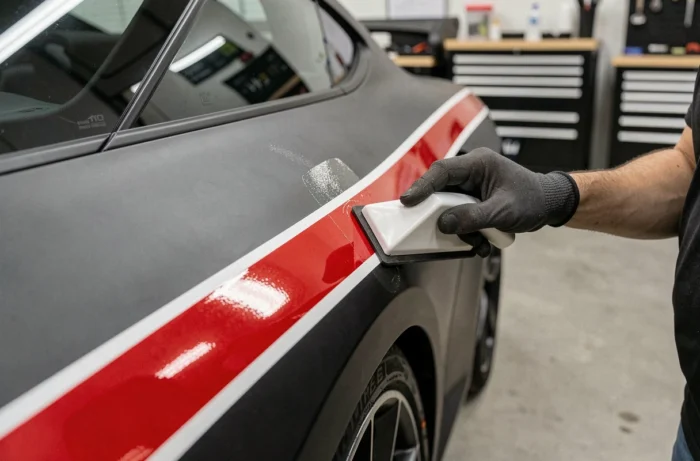
Decorative strips for automotive bodywork come in dozens of variations: side strips, windshield banners, complete racing kits. Comparing these options requires distinguishing the materials, uses, and regulatory constraints specific to each type of installation. Here’s what the technical data allows us to clarify.
Calendered vinyl or cast vinyl: the material that changes the durability of auto strips
The choice of adhesive film determines longevity and visual appeal. Two main families of vinyl dominate the Motorsport strip and automotive customization sticker market.
Calendered vinyl, which is less expensive, is suitable for flat surfaces and temporary installations. Its rigidity makes it difficult to apply on pronounced curves (fenders, bulging bumpers).
Cast vinyl, being more flexible, conforms to complex contours and better withstands UV rays as well as weather conditions over several years. It is the preferred material for complete racing kits and decorations intended to remain in place for a long time.
Specialized manufacturers of Motorsport strips typically offer professional-grade cast vinyl, with an additional lamination layer to protect the print from micro-scratches.
| Criterion | Calendered vinyl | Cast vinyl |
|---|---|---|
| Flexibility on curves | Limited | Excellent |
| Outdoor lifespan | Several years | Significantly longer |
| UV resistance | Medium | High |
| Relative cost | Lower | Higher |
| Main use | Occasional stickers, flat surfaces | Full covering, sport strips |
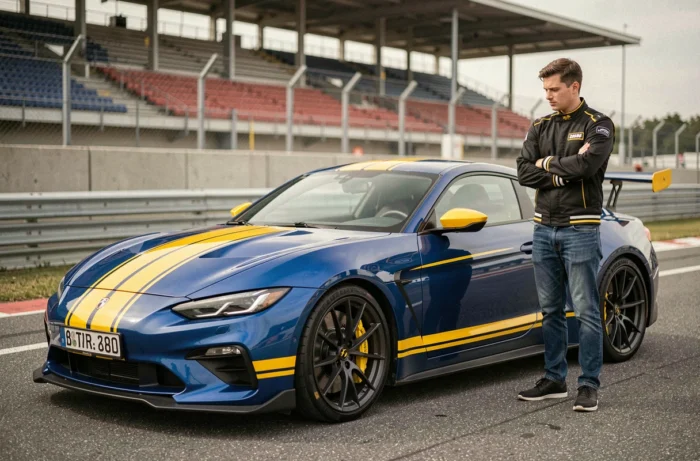
Windshield banner and French regulations: light transmission and authorized zones
Motorsport-style windshield banners are among the most visible accessories on a customized vehicle. Their installation is governed by specific rules that many drivers are unaware of.
Article R316-3 of the Highway Code imposes a minimum light transmission rate for the windshield. Any opaque film or strip that descends too low reduces the field of vision and may result in a fine during a roadside check.
The authorized area for a decorative banner is limited to the upper part of the windshield, above the area swept by the wipers. In practice, this corresponds to a relatively narrow strip. Commercially available banners often have a standard height, but the actual usable height depends on the vehicle model and the curvature of the glass.
Mandatory stickers and available space
As of April 1, 2024, the green insurance sticker is no longer mandatory on the windshield in France. Verification now occurs through the File of Insured Vehicles (FVA) directly consulted by law enforcement.
This removal frees up a space at the bottom of the windshield. However, other stickers remain required in certain cases: the Crit’Air sticker in low emission zones and the CMI badge for parking for persons with disabilities. A Motorsport banner must never obscure these mandatory elements.
Side strips and racing deco kit: protecting the bodywork while customizing the style
Beyond sporty aesthetics, side adhesive strips play a concrete role in protecting the paint. A vinyl film applied to the sides absorbs gravel projections, parking scrapes, and everyday micro-scratches.
- Side strips cover the areas most exposed to impacts (rocker panels, wheel arches, door edges) and can be replaced for a fraction of the cost of a paint touch-up.
- A complete deco kit (hood, roof, trunk) unifies the vehicle’s style while creating a sacrificial layer that preserves the original varnish, an asset for resale.
- The available finishes (matte, glossy, satin, carbon) allow for adapting the look to the vehicle’s style, whether it’s a city car or a sporty coupe like BMW or Porsche.
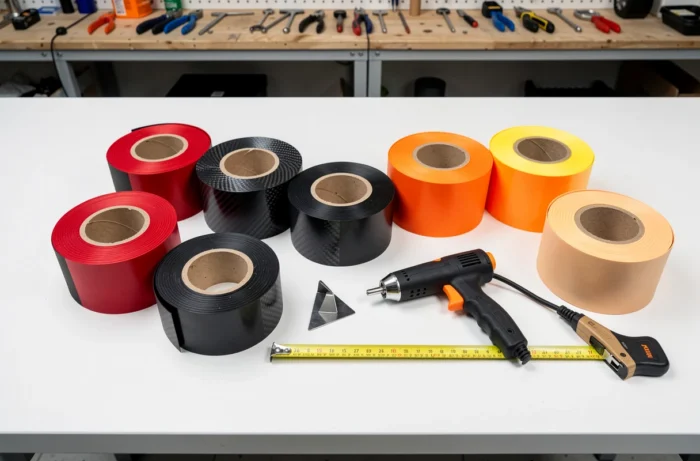
Dry installation or wet installation: two methods, two results
Wet installation uses a soap-water mixture sprayed on the bodywork before applying the film. This technique allows for repositioning the sticker for a few minutes, reducing the risk of air bubbles. It is suitable for large surfaces (hood, roof).
Dry installation offers immediate adhesion and works well for narrow strips or small stickers. On curved parts, wet installation remains the most reliable method to avoid wrinkles.
Maintenance and lifespan of vinyl strips on bodywork
A properly installed and maintained cast vinyl retains its appearance for several years. A few precautions can significantly extend its lifespan.
- Wash the vehicle by hand or with a low-pressure jet. Automatic car wash rollers can lift the edges of the film.
- Avoid aggressive solvents and abrasive polishes directly on the vinyl. A neutral cleaner is sufficient.
- Park in the shade or under cover when possible: prolonged exposure to UV rays is the primary factor in degrading the adhesive film.
- Regularly inspect the edges of the film, especially after a harsh winter. An edge that lifts can be quickly re-glued before water seeps under the vinyl.
Removing a quality vinyl film generally leaves no trace on the original paint, provided you gently heat the film with a heat gun and pull slowly. However, a low-quality vinyl left too long may leave more difficult-to-remove adhesive residues.
The choice of material and adherence to regulatory zones determine both the longevity and legality of the customization. A properly installed cast vinyl protects the bodywork, passes technical inspections without difficulty, and can be cleanly removed when the style evolves.