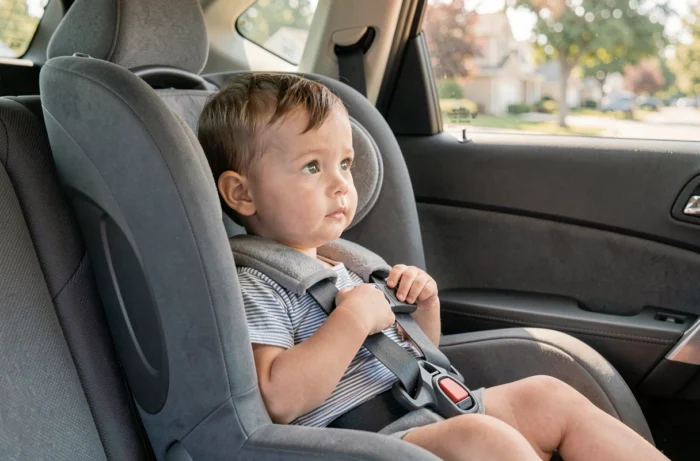
Installing a child in a car may seem trivial, but the choice of car seat directly determines the level of protection in the event of a collision. Since European regulations have evolved, the criteria for assessing the safety of a car seat in 2024 are no longer the same as they were a few years ago. Understanding these changes allows for a truly protective purchase, not just a compliant one.
Why the R129 standard changes the game for car seat safety
Previously, car seats were classified by the child’s weight, according to the old R44 regulation. This system often led to mistakes: a parent would choose a group based on the weight indicated on the packaging, without knowing if their child’s physique actually matched the seat.
The UN R129 regulation, also known as i-Size, has replaced this logic. R129 classifies seats by the child’s height rather than weight. In practical terms, you measure your child and choose a seat whose height range corresponds. This change reduces installation and compatibility errors.
Another major advancement: R129 mandates a mandatory side impact test. The old R44 only tested frontal impacts. R129-approved seats must therefore protect the head and torso during a side impact, which represents a significant portion of serious accidents. You can check a car seat comparison on Maman Anonyme that details the models meeting these enhanced requirements.
As of September 1, 2024, R44-approved seats are banned from sale in the European Union. Their use remains permitted, but any new purchase must have R129 approval. Checking this mention on the seat’s label is the first reflex to adopt.

Rear-facing: the most underestimated car seat safety criterion
Have you ever noticed that infants always travel rear-facing? This is not just a common practice; it is a regulatory requirement. R129 mandates rear-facing until at least 15 months. The reason is physiological: a young child’s head is proportionally heavy compared to their body, and their cervical vertebrae are not yet solidified.
In the event of a frontal collision, a child facing forward experiences a violent projection of the head forward. Rear-facing, the force is distributed across the entire back and neck. The difference in protection is significant.
The legal minimum is 15 months, but road safety specialists recommend extending this position for as long as possible. Some i-Size seats allow for rear-facing travel up to 105 cm or more. This is a crucial selection criterion, even if the child seems cramped: a child who bends their legs rear-facing is better protected than a child facing forward.
When to switch to forward-facing
The transition to forward-facing should not be made for comfort or habit. The right time depends on the maximum height allowed by the seat in the rear-facing position. As long as the child’s head does not exceed the top of the shell, the position remains safe.
Isofix or seatbelt: what impact on protection
There are two methods to secure a car seat in a vehicle: the seatbelt and the Isofix system. The difference is not limited to practicality.
The Isofix system uses metal anchor points integrated into the vehicle’s structure. The seat clips directly in, with a visual indicator (often green) confirming correct locking. Isofix significantly reduces the risk of incorrect installation, which remains one of the main causes of preventable injuries.
Installation using the seatbelt works, but it requires more attention. The path of the seatbelt must follow a precise route, without twisting, with sufficient tension. A sloppy installation can leave play and reduce protection.
- Isofix with a support leg or top tether: the most stable fixation, recommended for rear-facing seats and second-stage seats
- Seatbelt only: acceptable if the vehicle does not have Isofix anchors, but requires thorough checking on each trip
- Separate Isofix base: convenient for newborn carriers, allowing you to clip and unclip the carrier without reinstalling each time
Rotating and convertible car seats: comfort or real safety
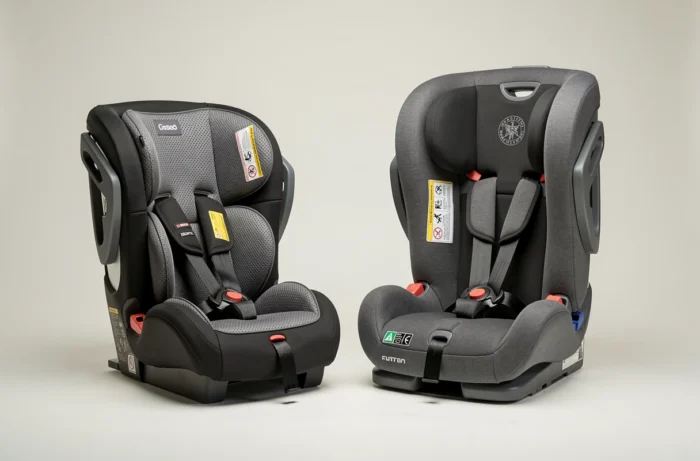
Rotating seats are becoming increasingly popular. Their mechanism allows the seat to turn towards the door for easy child installation, then reposition to face forward or rearward. This is a real comfort gain in daily use, especially in compact vehicles.
The legitimate question: does this mechanism add a point of weakness? In R129-approved models, the rotation mechanism is tested under the same crash conditions as fixed seats. An R129-approved rotating seat offers a level of safety equivalent to a fixed seat.
Convertible seats cover several growth phases. A model can accommodate a child from birth up to about 105 cm, transitioning from rear-facing to forward-facing. The economic advantage is clear, but one specific point must be checked: the height range covered in the rear-facing position. Some models switch to forward-facing as early as 76 cm, which is still too soon for adequate protection.
What matters beyond price
A €150 R129-approved seat protects better than a €400 model that remains under the old R44 standard. The price often reflects the comfort of materials, the rotation system, or the brand, not necessarily the level of safety. R129 approval and the duration of use rear-facing are the two most reliable indicators.
- Check for the mention “UN R129” or “i-Size” on the seat’s approval label
- Compare the maximum height allowed in the rear-facing position among several models
- Test the installation in your vehicle before purchase, as not all seats are compatible with all cars
- Prefer a seat with a harness rather than an impact shield for children under 4 years old, as the harness better secures the torso in the event of a side impact
The best car seat for your child in 2024 is not necessarily the most expensive or the newest. It is the one that carries the R129 approval, allows for rear-facing for the longest time possible, and that you know how to install correctly on every trip. A poorly installed seat, even a high-end one, does not provide protection.