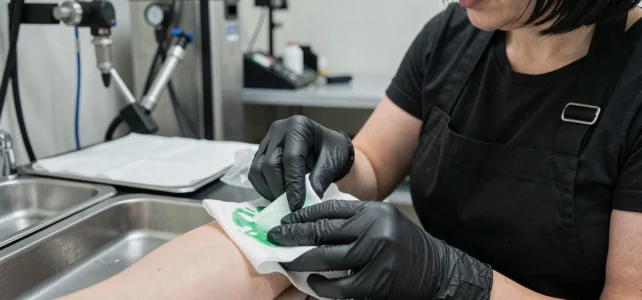
The tattoo stencil is a transfer made with hectographic ink (most often purple) applied to the skin to guide the artist’s drawing. Once the session is over, this visual guide no longer needs to remain visible. Removing it cleanly, without irritating skin already stressed by the needles, requires a protocol adapted to the type of product used and the skin condition post-session.
Why the initial drying of the stencil affects its removal
A point rarely addressed in product sheets for stencil removers: the quality of removal directly depends on the initial fixation of the transfer. A stencil that is properly dried before the start of the tattoo (between ten and twenty minutes depending on the gel or spray used) adheres evenly to the skin.
Conversely, a poorly fixed stencil smudges and shifts during the session. The hectographic ink then mixes with bodily fluids and residual tattoo ink. The final cleaning becomes longer, and the risk of excessive rubbing on an already irritated area increases.
This link between good preparation beforehand and clean removal afterward is documented in technical guides focused on studio workflow. Specifically, taking the time to let the transfer dry reduces the likelihood of seeing a persistent “purple ghost” after the session. Knowing how to remove a stencil after a tattoo thus begins well before the cleaning gesture itself.
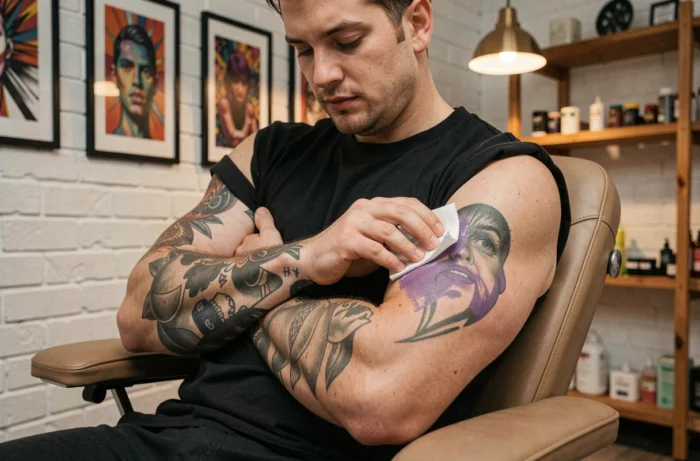
Dedicated stencil eraser or isopropyl alcohol: choosing the right product
Two main families of products coexist to remove stencil residue after a tattoo. The choice between the two is not trivial, especially on freshly tattooed skin.
Stencil removers formulated for tattooing
Products specifically designed to dissolve hectographic ink (often called “stencil erasers”) contain cleaning agents calibrated to act on the purple pigment without damaging the superficial layer of the skin. Some formulations include aloe or other soothing components.
Their main advantage is the reduction of friction needed. The product chemically dissolves the transfer, which limits the number of mechanical passes over the tattooed area. For a tattoo with fine lines or in sensitive areas, this difference matters.
Isopropyl alcohol: effective but to be limited
Isopropyl alcohol remains the most common option in many studios. It quickly dissolves the transfer ink and provides immediate visual cleaning.
However, recent professional resources recommend limiting the use of alcohol on freshly tattooed skin. When applied repeatedly or for extended periods, it dries out the epidermis and can cause redness or even local chemical burns on the areas most worked by the machine.
The recommendation emerging from practice guides: reserve alcohol for non-tattooed areas (periphery of the stencil, edges of the stencil that extend beyond the tattoo) and use a dedicated eraser on the tattooed area itself.
Technique for removing the stencil without irritating the tattooed skin
The cleaning gesture is as important as the product chosen. Rubbing vigorously on a stubborn transfer on skin that has just undergone thousands of micro-perforations causes unnecessary irritation.
- Apply the product (eraser or diluted alcohol) on a clean non-woven compress, never directly on the skin, to control the amount deposited.
- Pat the area with gentle, short movements rather than vigorous back-and-forth motions. Patting dissolves the pigment without pulling on the fragile epidermis.
- Work in small sections starting from the outside of the stencil towards the center of the tattoo, to avoid pushing transfer ink residues into open areas.
- Wipe off excess product with a clean compress moistened with sterile water after each pass, to avoid leaving any chemical agent stagnant on the skin.
If a purple residue persists after two or three passes, it is better to let the skin rest. Residual stencil marks disappear naturally within a few days with cellular renewal and regular post-tattoo care.
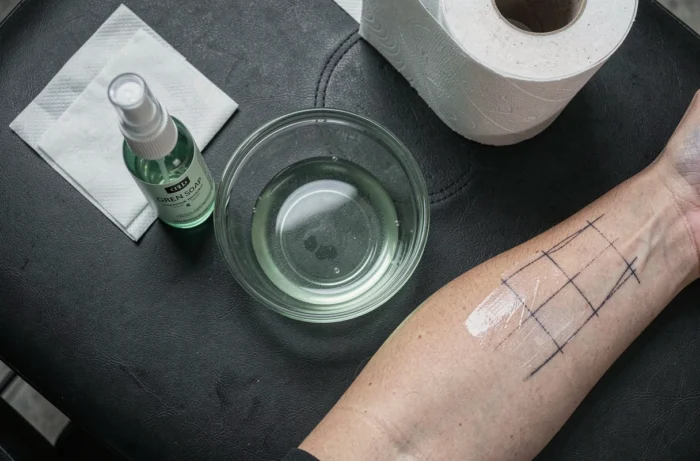
Household products and home remedies: what works and what to avoid
On forums and social networks, suggestions abound: coconut oil, Marseille soap, nail polish remover. Not all are equal, and some pose a real risk for a fresh tattoo.
Acetone-based remover should be avoided on recently tattooed skin. Acetone is an aggressive solvent that penetrates the upper layers of the epidermis and can disrupt healing, even partially discoloring the pigment of the tattoo still in the fixing process.
Gentle antibacterial soap (the one recommended for post-tattoo care) can help fade light stencil residues during daily cleaning. It does not replace a dedicated product for immediate removal at the end of the session, but it helps to eliminate the last traces over the days.
Vegetable oils (coconut, sweet almond) partially dissolve hectographic ink. They are gentle on the skin, but their greasy film can clog micro-lesions and slow healing if applied too early. Waiting at least until the end of the weeping phase before using a greasy substance on the tattooed area remains the basic precaution.
Post-session care and natural disappearance of marks
A properly applied stencil that is then cleaned with the right product rarely leaves marks beyond a few days. The epidermis’ renewal cycle, combined with moisturizing care applied during healing, does the rest of the work.
The standard care protocol (bi-daily cleaning with gentle soap, applying a thin layer of healing cream) is sufficient to gradually eliminate the last hectographic pigments trapped on the surface. No additional product is necessary once the session is over and the bulk of the stencil is removed.
The real determining factor remains the respect for the complete chain: careful skin preparation, drying time of the transfer, methodical removal with an appropriate product, and then classic healing. Each well-executed step simplifies the next one.