
69 psi corresponds to 4.76 bar in gauge pressure, which is the result of 69 multiplied by the exact factor 0.0689476. This number seems simple, but conversion errors almost never arise from the calculation itself. They lurk in the confusion between types of pressure, in successive rounding, and in the misreading of the units displayed on a gauge or tire sidewall.
Gauge pressure and absolute pressure: the trap that the formula does not solve
The formula 1 psi = 0.0689476 bar works in all cases. The real trap lies upstream: knowing whether the value of 69 psi is expressed in gauge pressure (psig) or absolute pressure (psia).
A tire gauge displays gauge pressure, which is the pressure relative to the ambient atmosphere. The 69 psi read on an inflation controller indeed gives 4.76 relative bar. In absolute pressure, you would need to add about 1 bar (the standard atmospheric pressure), bringing the value to about 5.76 absolute bar.
This distinction has no impact for tire inflation, but it changes everything as soon as you work with the ideal gas law or volume calculations under pressure. We regularly observe this confusion in industrial applications and diving, where mixing bar(g) and bar(a) significantly skews the results.
When you encounter the conversion of 69 psi to bar in a technical context, always check if the source document specifies psig or psia before applying the formula.

Exact conversion factor psi to bar: why rounding causes problems
The exact factor is 1 psi = 0.0689476 bar. Many online charts round to 0.069 or even 0.07. For a single conversion, the difference remains minimal. However, in chain calculations or at high pressures, the error accumulates.
Let’s take the case of 69 psi:
- With the exact factor (0.0689476): 69 x 0.0689476 = 4.7574 bar, rounded to 4.76 bar
- With the simplified factor (0.069): 69 x 0.069 = 4.761 bar, which is a difference of a few thousandths
- With the truncated factor (0.07): 69 x 0.07 = 4.83 bar, which is a difference of 0.07 bar that exceeds the tolerance of many gauges
A good quality digital gauge displays a resolution of 0.01 bar. Using a factor rounded to 0.07 introduces an error greater than the instrument’s precision, making the conversion practically useless.
We recommend keeping at least four decimal places on the factor (0.0689) for any application where the tolerance is less than 0.05 bar.
Inverse conversion: from bar to psi
The inverse factor is 1 bar = 14.5038 psi. To verify a conversion, multiply 4.76 bar by 14.5038: you get 69.04 psi, consistent with the starting value. This cross-check immediately detects a rounding error or a factor inversion.
Relationship between psi, bar, kPa, and atm: avoiding unit confusion
Gauges on the European market often display bar. North American equipment uses psi. Automotive technical specifications sometimes mention kPa, and certain diving or physics standards use atmosphere (atm).
69 psi is equivalent to 475.7 kPa (69 x 6.89476) and approximately 4.69 atm (69 / 14.696). These equivalences are rarely given together in public conversion charts, leading to errors when a technician switches from one reference to another.
The classic trap: confusing bar and atm. The difference between 1 bar and 1 atm is small (1 atm = 1.01325 bar), but for 69 psi, the difference between 4.76 bar and 4.69 atm represents 0.07 units. Enough to skew a pneumatic suspension setting or an industrial calibration.
Application for bike and road tires: 69 psi in real context
On a road bike tire, 69 psi (4.76 bar) is at the low end of typical pressures. It is a reasonable value for a heavy cyclist on a wide tire (over 28 mm) or for gravel on soft terrain.
On a mountain bike tire, 69 psi would be excessive: typical pressures drop well below that. Conversely, on a car, this pressure far exceeds manufacturer recommendations.
Always check the range indicated on the tire sidewall before inflating. Manufacturers specify a maximum pressure in psi and bar. If your pump displays only one unit, the conversion must be reliable, not approximate.
Reading the tire sidewall and dual scale
Most bike tires have an inscription like “max 100 psi / 7 bar”. If your gauge displays only psi and you aim for 4.76 bar, you must convert this target to 69 psi before inflating. Reversing the conversion (reading 69 on the gauge in bar instead of psi) leads to dangerous overinflation.
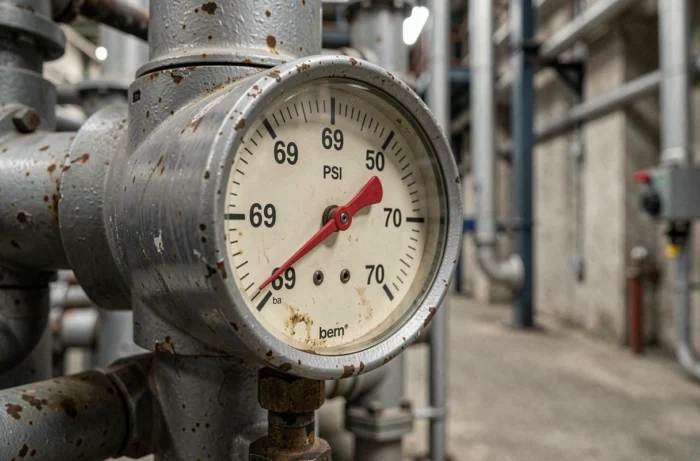
Quick mental calculation method to convert psi to bar
Dividing by 14.5 is the most reliable shortcut. For 69 psi: 69 / 14.5 = 4.76 bar. Dividing by 15 (easier to do in your head) gives 4.6 bar, which is a difference of 0.16 bar, too large for precise adjustment.
An alternative: divide by 10 then multiply by 0.69. For 69 psi: 6.9 x 0.69 = 4.76 bar. This method takes advantage of the numerical coincidence of the value 69 and works less well for other pressures.
For any critical application, mental calculation does not replace a digital converter or a dual-scale gauge. The approximation remains useful as a consistency check, not as a reference value.
The last point to remember: tire temperature affects actual pressure. A tire inflated to 69 psi when cold will show a higher value after riding. Converting this hot pressure to bar poses no formula problem, but the value obtained will no longer correspond to the initial set pressure. Inflation and measurement should always be done when cold.