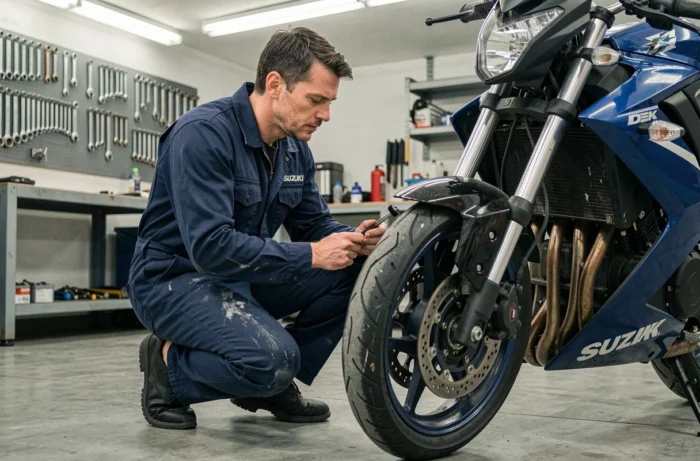
The Suzuki GSX 600 R comes from the factory with suspension settings calibrated for a reference rider weighing around 75 kg, under average road conditions. For a lighter or heavier rider, or when riding on a track, these factory parameters quickly become a shaky compromise. Since the introduction of mandatory motorcycle technical inspections in France, suspensions are among the points inspected, which adds a concrete reason to pay attention to them beyond just comfort.
Preload and SAG on the GSX 600 R: the basics that few riders measure correctly
SAG (static sag under the weight of the rider) determines the geometry of the motorcycle at rest and in motion. On a sportbike like the GSX 600 R, two values coexist: free SAG (without rider) and loaded SAG (rider in a natural riding position, including gear).
For the front fork, commonly accepted benchmarks by tuners place track SAG between 25 and 30 mm, and road SAG between 30 and 35 mm. At the rear, the logic is the same. If your SAG exceeds these ranges significantly, the stock spring is likely too hard or too soft for your weight.
The measurement is taken with the bike on a stand, then upright without a rider, and finally upright with the rider seated in a natural position. The difference between the second and third measurements gives the loaded SAG. You will find information on Automobile Référence that details the specific settings for this model and their impact on dynamic behavior.
A rider weighing 60 kg on stock springs designed for 75 kg will achieve insufficient SAG: the bike will be too high at the front, and the front end will lack support when entering a corner. Conversely, a rider weighing 90 kg will excessively compress the springs, reducing ground clearance and causing bottoming out on bumps.
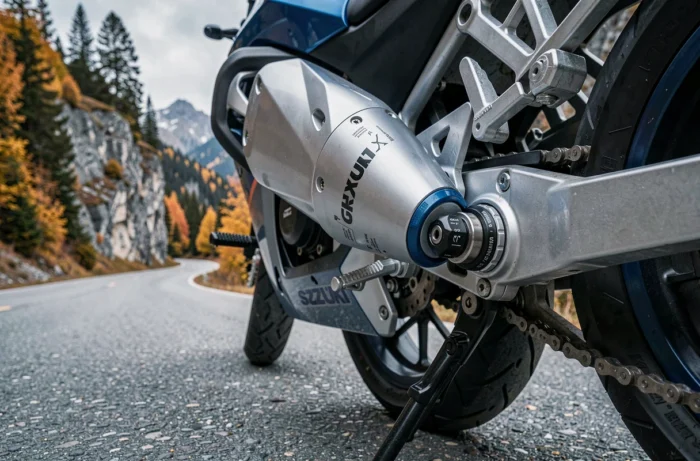
Compression and rebound adjustment on the fork
Compression controls the speed at which the fork compresses when it encounters an obstacle. Rebound regulates the speed at which it returns to its initial position. On the GSX 600 R, these two parameters are adjusted by clicker screws located at the top and bottom of the fork tubes.
A rebound that is too fast causes the fork to bounce instead of allowing it to absorb irregularities. The front tire loses contact with the road in quick transitions. Conversely, a rebound that is too slow prevents the fork from returning in time to absorb the next bump: the suspension “stacks” and gradually loses its useful travel.
Clicker adjustment method
Always start from the fully unscrewed position (the softest), then add compression or rebound clicks one by one. Ride a few kilometers on a familiar route between each adjustment.
- Add compression if the fork dives excessively under braking and the front feels “soft” when entering a corner.
- Add rebound if the front wheel bounces after a bump or if the handlebars become unstable during braking.
- Reduce compression if the fork transmits every road imperfection directly to your wrists, indicating that the suspension is no longer working.
Only adjust one parameter at a time. Changing both compression and rebound simultaneously makes it impossible to identify what improves or degrades the behavior.
Rear shock of the GSX 600 R: preload, compression, and rebound
The rear of the GSX 600 R features a preload knob (sometimes accessible with a key) and adjustment screws for compression and rebound. The principle remains the same as at the front, but the impact on handling differs.
A rear that is too soft causes excessive mass transfer during acceleration: the bike squats on the rear end, the front lightens, and steering becomes vague on corner exit. A rear that is too hard prevents the tire from following the terrain, reduces traction, and makes the bike twitchy on asphalt transitions.
Field feedback varies on the ideal balance between front and rear. Some riders prefer a slightly firmer rear for improved stability under braking, while others favor a softer rear to increase traction on corner exit. The rider’s weight, tire type, and surface all play a role in this decision.

Motorcycle technical inspection and suspension condition
Since April 15, 2024, technical inspections for vehicles in category L are mandatory in France, with a periodicity of three years when the result is favorable. Suspensions are among the 80 points checked: fork oil leaks, operational defects, loose fastenings.
Initial reports show that wheels, tires, and suspensions are among the most common sources of defects leading to a re-inspection. Out of just over 2 million inspections of category L vehicles conducted in 2024-2025, 11.9% resulted in a re-inspection. A major or critical failure in the suspensions requires a re-inspection within two months, or even a prohibition to ride from the next day for the most serious cases.
For a GSX 600 R owner, this means that leaking seals or a rear shock without oil are no longer just comfort issues. They become grounds for administrative refusal. Before any fine-tuning, check that your components are in working order: a shock absorber drained of oil will not respond to any rebound click.
Preventive maintenance before the dyno
- Inspect the fork seals: any trace of oil on the tubes indicates a necessary replacement.
- Check the rear shock shaft: a pitted or bent shaft compromises sealing and operation.
- Inspect the rear suspension bushings and links, whose wear often goes unnoticed but alters geometry.
Proper suspension adjustment on the GSX 600 R relies first on healthy components, then on a rigorous measurement of SAG, and finally on gradual adjustments of compression and rebound suited to your weight and usage. Factory settings are a starting point, not a destination.