
Priority checkouts have been part of the landscape of French supermarkets for decades. Their legal framework is based on the Code of Social Action and Families as well as the law of February 11, 2005, relating to disability. This right of priority is not limited to designated checkouts: it applies to all queues, including self-checkouts, even in the absence of a dedicated sign.
Legal obligation of priority at checkout: what the Code really provides
The most widespread confusion concerns the scope of this obligation. Many customers believe that only checkouts displaying a “priority” pictogram are affected. The legal reality is different: the right of priority applies to all queues, in shops, public services, and transport.
The obligation arises from Article L. 241-3-1 of the Code of Social Action and Families, which governs the mobility inclusion card (CMI). This card, issued by departmental houses for disabled persons (MDPH), includes a mention of “priority” or “disability” depending on the holder’s situation. It has replaced the old priority and parking cards for several years.
For those who wish to learn more about Le Off, the concrete functioning of these checkouts and the rules of etiquette surrounding them deserve careful attention.
The 2005 law also expanded the circle of beneficiaries beyond visible disabilities. Pregnant women, elderly people with mobility difficulties, and holders of the CMI with the mention “priority” all have the same right, without having to justify their situation to other customers.

Mobility inclusion card and proof of priority: who can go ahead
The official document that grants the right of priority at checkout is the mobility inclusion card with the mention “priority”. It concerns individuals whose disability makes standing painful, without necessarily implying a wheelchair or a visible disability.
Beneficiaries are divided into several categories:
- Holders of a CMI with the mention “priority” or “disability,” issued by the MDPH after assessing the degree of disability or difficulty in standing
- Pregnant women, who effectively benefit from a right of priority in most stores, even without specific documentation
- Elderly individuals with mobility difficulties, often recognized by a simple visual assessment by checkout staff
- Individuals accompanied by young children in certain stores, although this category is more about courtesy than a strict legal obligation
A delicate point deserves to be raised. Invisible disabilities represent the majority of disability situations in France. Chronic illnesses, heart conditions, fibromyalgia, mental disorders: all conditions that make prolonged standing painful without anything being apparent. It is precisely in this area that tensions at checkout are most pronounced.
Invisible disability and tensions at checkout: the crux of the problem
The main difficulty with priority checkouts does not lie in the legal framework. It lies in the perceptions of other customers. When a seemingly able-bodied person presents their CMI or requests priority, reactions range from polite confusion to outright hostility.
Arnaud Denis, co-managing director of Handivisible, has developed a digital solution to address this specific problem. The Handivisible app generates a visual or a QR code that the person can present at checkout, thus avoiding the need to explain their disability at every visit. The system has been deployed in over 300 stores according to available data.
This type of solution addresses a documented reality: many people with disabilities refrain from asserting their right of priority for fear of conflict or humiliation. The issue is not technical or regulatory; it is psychological and social.
The Priocall kiosk in-store
Some retailers have installed connected kiosks, such as the Priocall system, which allow priority individuals to signal their presence without directly addressing staff or other customers. The kiosk alerts an employee, who then accompanies the person to an appropriate checkout.
This system has a concrete advantage: it eliminates the need to “beg” for a place in line. Feedback on this point varies; some retailers report rapid adoption while others observe underutilization due to a lack of signage or staff training.
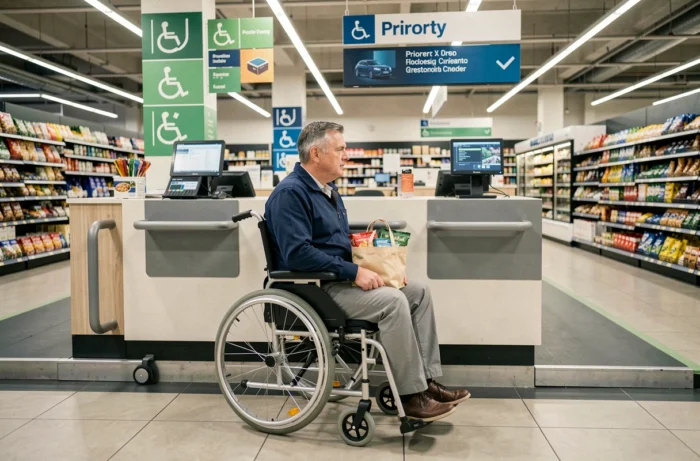
Self-checkouts and the right of priority: a persistent blind spot
The massive deployment of self-service checkouts has created a gray area. These checkouts operate without a dedicated line, with a single queue managed by a screen or an employee. The notion of “priority checkout” becomes blurred.
However, the right of priority applies in the same way. The law does not distinguish between traditional checkouts and self-service checkouts. A person holding a CMI can request to go ahead in the common queue of self-service checkouts, just as they would at a traditional checkout.
In practice, this priority is rarely respected in automated spaces. The absence of a cashier identified as a point of contact complicates the process. The individual must address the supervising employee, who may not have received specific training on this subject.
Staff training and retailer responsibility
Training of checkout teams remains an underutilized lever. Retailers like Carrefour display priority welcome policies, but implementation largely depends on the store and its manager.
Several factors condition the effectiveness of the system:
- The initial training of cashiers in recognizing the CMI and welcoming individuals with invisible disabilities
- Clear and visible signage, not only at dedicated checkouts but also in self-checkout areas
- The existence of a disability referent in-store, capable of intervening in case of conflict between customers
The MDPH in some departments, such as those in Aube and Marne, have begun to directly inform CMI holders about the digital solutions available in stores. This proactive approach remains minority at the national level.
The legal framework exists, technological tools are developing, but friction persists at the human level. As long as the majority of customers associate priority at checkout with a visible disability, individuals with invisible disabilities will continue to hesitate before asserting a right that fully belongs to them.